
OBITUARY
Mr. Leonard Casciato BA, MA, P.Eng
August 7, 1925 – June 3, 2020
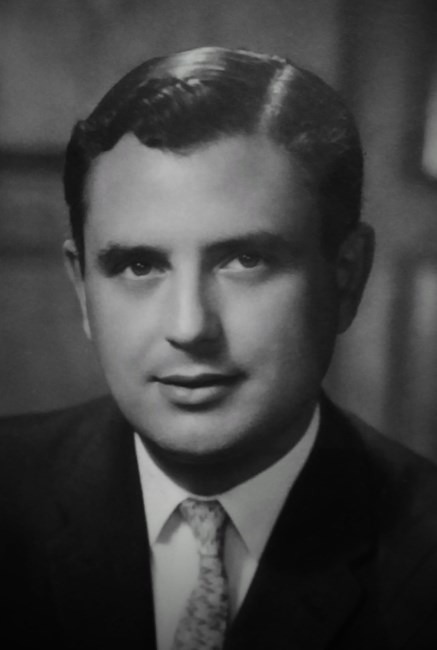
The engineering whiz kid whose technological innovation created computer-controlled traffic systems and revolutionized public transport in Canada and across the world came to his final stop in a Kitchener care home on Wednesday.
Leonard P. Casciato helped design and build Canada’s first computer between 1948-1950, while he was a student at the University of Toronto.
A decade later, he designed and installed the first electronically controlled traffic system in the world in Toronto in 1962, and in the 1970s began the electronic revolution at the Toronto Transit Commission that now allows it to safely whisk millions of commuters to work every day.
His string of patents and work informed everything from the use of early cellular communications to track vehicles to the free-flowing movement of traffic in cities, automated reservations for airlines as well as inventory, accounting systems and automated production lines.
He was pre-deceased by his wife Loretta (nee Carey) and leaves behind four children: John, Paul, Mary-Ellen and Anne Marie; seven grandchildren: Adam, Christopher, Lauren, Jack, Max, Michael and Colleen; three step-grandchildren: Chris, Devin and Kelton; and three of his four siblings: Evelyn Fontana (nee Casciato), Joe Blondin and Anthony Casciato.
Born near Christie Pitts in 1925 to his Scottish mother Jean (nee Jane Urquhart) Casciato, a former WWI munitionette and Adam Casciato, a local Toronto football and baseball champion who worked as a luggage maker for Eaton’s, Leonard was a life-long striver.
Top of his class at St. Peter’s Catholic primary school near Bathurst and Bloor, Casciato won an academic scholarship to St. Michael’s College School. His competitive nature and drive earned him a gold medal for coming first in every subject for four years running.
Alas, in the fifth year, he fell off his bicycle on his way to a French exam, broke his arm, turned up late and failed to top the class. His unsparing Scottish mother never let him forget that he was always one medal short of a full set.
The story of the Casciato family is woven into the fabric of Toronto and Canada.
His grandfather Enrico, an illiterate peasant from Abruzzo, Italy, immigrated to Canada just after Italian unification and around the same time as Canadian confederation. He was a labourer who dug the foundations of what is now “old City Hall” and earned extra money as an organ grinder with a monkey.
His son and Leonard’s father, Adam was a top sportsman, excelling and winning championships for local Toronto amateur teams at football and baseball and playing for teams at Christie Pitts into his forties. He enlisted in the Canadian Cavalry in WWI, but an injury as a result of falling from a horse spared him the horrors of the first world war.
Although he grew up during the Depression, followed by World War Two and money was tight, Leonard’s academic prowess afforded him a High School scholarship to the private Catholic St. Michael’s College School run by Basilian priests and then located at Bay and Bloor. Another scholarship made it possible to carry on to the University of Toronto to study a five-year math and physics program starting in 1943.
During his school years, the world was ablaze with World War Two and Leonard burned to do his bit for Canada. He took a break from his studies at the University of Toronto to enlist in the Royal Canadian Air Force as soon as he was of age, but the war ended by the time he could ship overseas as a fully qualified pilot.
“I was disappointed,” he said. “I wanted to get into a really hot plane like a Hurricane or a Spitfire.”
So he resumed his place at the University of Toronto, where he was asked to get involved in building Canada’s first computer alongside Canada’s other computer pioneer and future business partner Josef Kates. The two worked in a team that also included a University of Cambridge protégé of the enigma code-buster Alan Turing to create UTEC, the University of Toronto Electronic Computer at U of T’s Computation Centre.
The “Mechanical Brain” as the Globe & Mail called it was functional by the fall of 1950, making about 5,000 calculations a second and running for periods of up to eight hours without hardware fault. Input was handled via a Teletype machine and information storage was handled by several extremely delicate Williams vacuum tubes.
“You comb your hair and that would be enough to destroy the contents of the electrostatic storage tubes if you weren’t careful,” said Casciato in 1992. “That is where my practicality came in, because I was able to shield, protect, and otherwise reinforce the electrics to make them function well.”
Shortly after university, he and Kates set out to form a new company called Digitronics and attempted to get funding to build their own computer for business purposes that could be employed for use in inventory control, automated reservation systems, accounting, automated process control in manufacturing and office filing systems. Their ideas were considered radical at the time.
But they attracted the attention of Robert Watson-Watts, the inventor of radar, who employed them in his Montreal high-tech consulting company Adalia Ltd, where the pair worked on the introduction of computerized systems for Trans-Canada Airlines.
The relationship with Adalia eventually broke down over their interest in computer hardware and in 1954 Casciato and Kates formed KCS Data Control Ltd alongside a new partner Joe Shapiro.
The company became Canada’s most successful computer consulting company in the late 1950s and 1960s, playing an important role in the technology decisions of big business and the Canadian government, including real-time process control technology for the Canadian petro-chemical industry and a string of patents.
But the biggest success for KCS and Casciato as its Chief Engineer was the design and deployment in Toronto of the world’s first computerized urban traffic control system in Toronto in 1962. Its successful deployment was celebrated in 1964 by the American Society of Traffic Engineers, which held its annual conference in Toronto in 1964, the first time it had ever been held outside of the United States.
Toronto’s Financial Post called it “magic”, the Globe and Mail and the Toronto Star referred to it as the “electronic brain” that could solve Toronto’s traffic problems in seconds.
Success and more work came into the firm to automate production facilities at places as far flung as Norsk Hydro in Norway.
Casciato travelled on business to Switzerland, Germany and France. He made friends in Parisian society, went golfing with the President of the Bank of France, met Pablo Picasso’s muse Francoise Gilot and impressed the great and the good with his technological ideas.
But Kates and Casciato eventually fell out over business differences, the KCS partnership was dissolved and sold to Toronto accounting firm Peat Marwick, which later became the global firm KPMG.
Casciato and Kates went their separate ways for several years. Josef Kates was the Steve Jobs to Casciato’s Steve Wozniak-like technical brilliance, an impresario whose drive for innovation spurred Leonard’s technological ingenuity. Kates went on to shine in the limelight, capitalizing on the KCS success to become chairman of the Science Council of Canada and receiving the Order of Canada.
Embittered and enriched by the break-up of their partnership, Leonard used the next few years to pursue his other passions.
He loved flying and was a keen Francophile, speaking fluent French, studying at the Sorbonne in Paris, taking his family on long family car trips to Quebec and enjoying life-long membership of Alliance Francaise.
His insatiable interest in planes led him and a friend to re-build by hand a Tiger Moth biplane from the parts of seven wreckages. He joined the Downsview Flying Club and was honoured to be made a member of the Officer’s Mess by the RCAF pilots still stationed there and kept a plane there for many years, before it closed down.
At home in Toronto’s North York, his basement workshop was always a hive of Thomas Edison-like activity with lasers, machines, tools, models and other items of technological wonder always under construction.
In the early 1970s, he was called back into service by Peat Marwick when the second largest transit system in North America, the Toronto Transit Commission wanted to create a computer and communications system to link up transport networks.
Casciato was brought in to help design and create the TTC’s Transit Universal Microprocessor system or TRUMP, the forerunner of the communications and computerized equipment that now runs the system.
The appearance of computer-like terminals on buses and trams across Toronto came after work, which required Casciato to obtain a bus driver’s license so he could test out the system. He could often be found driving his children around the bus depot on Spadina Ave on weekends to artificial stops where they could get on and off to simulate passengers monitored by the system.
He was once laughed out of the TTC boardroom for proposing they buy up the cheap radio frequencies, predicting they would form the infrastructure of a modern telecommunications revolution that would provide enough income to make public transport free for everyone in Toronto. One wonders who is laughing now.
Having been at the start of the computer revolution, Casciato remained a consultant for hire for many years. But he became disillusioned with the computing industry, considering the focus on complicated programming languages to be a distraction from computing’s real purpose. To make life and work easier for humans.
He was scathing about computer programmers and the complicated early prototypes of business and personal computers, which required sophisticated knowledge of programming as awkward and unworkable for practical use.
“If computer programmers designed cars, you’d have to get out to change gears while driving,” he once said.
But he was an early adopter of Apple computers, buying its first commercial edition and praising Steve Jobs for the built-in intuition of an operating system that was designed to make it possible for anyone to use.
In his personal life, Leonard was a passionate Canadian.
His grandfather immigrated to Canada with nothing. His father worked in the basement of the Toronto shop of Canada’s iconic department store Eaton’s at the corner of Yonge and King.
His own story was a testament to the opportunities open to millions of immigrants who flocked to Canada to build a new life for themselves and their families.
His corner office at KCS in the gleaming new Simpson’s Tower built for the Who’s Who of Canadian business, cast its shadow over old City Hall where his grandfather wielded pick and spade and the shop where his jovial dad made hand-tooled luggage. On business trips around the planet, automating plants and processes, Leonard carried a personal set made by his father that was embossed with his name in silver.
Leonard was a life-long Liberal and an ardent believer in Prime Minister Pierre Trudeau’s vision of a cultural mosaic, which could transform the destiny of anyone willing to grasp the nettle.
As a child, he suffered at the hands of discrimination that affected him his whole life. His mother’s Scottish relatives openly referred pityingly to Jean’s unfortunate marriage to “the dago” and referred to Leonard as ”the little dago”.
As a young man he wore a “wind-cheater” jacket zipped all the way up to his neck and pulled down to his hands as he cycled around the city, so passersby couldn’t see his olive skin. He often recalled a sign at the popular Hanlan’s Point beach in the 1930s that read: “No Jews, No Dogs and No WOPS”.
He never forgot the burning injustice of discrimination and set out to prove to everyone, that as he said: “It’s what you do, that defines you.”
His first business partner was a Jewish refugee who escaped the Nazis. Many of his school friends didn’t return from the war, yet the two of them employed a former German U-Boat commander at KCS.
When this former POW captured off Canada’s coast arrived at the door of Leonard’s office and clicked his heels in military fashion, Leonard looked up at him and said: “You don’t have to do that anymore, this is Canada.”
He was a big fan of Johnny Lombardi’s CHIN radio and later television, which allowed him to shed the childhood shame of his background and share pride in his Italian heritage with his own children.
He went to Metro Toronto’s Caravan festival every year, relishing the chance to enjoy the rich offerings of a week-long jamboree which showcased the food, music, and other cultural traditions of the immigrant population in Toronto.
His town.
He would visit Toronto’s Little Italy later in life, for a meal in an Italian restaurant and a wander past the old house where his grandfather used to apologize to his clever young Canadian grandson for speaking in “this monkey language” with fellow Italian immigrants.
In the late 1950s Leonard married a sweetheart from St. Peter’s school, Loretta Carey. She was the descendant of Irish immigrants working in the timber camps and nickel mines of Northern Ontario, sent to live with her maiden aunts in Toronto after a family tragedy that killed both of her parents.
The two set about making a home for themselves in North York, with plans for a big family. Loretta became a charity figure with the Catholic Women’s League and the Catholic Children’s Aid Society (CCAS), UNICEF and others.
Unable to conceive children, they adopted four infants through the CCAS. Their adoption was never a secret.
“I was already at the charity, so I just took all the best babies home to love,” she would tell them when asked about their adoption.
She and Leonard taught all their children to be fiercely independent, changing the children’s’ stars as they had changed their own
Leonard could also be a hard taskmaster and he was cursed with a volcanic temper.
He quietly helped improve the math skills of a generation of Canadians from behind the scenes.
Math homework sessions with his own children often ended with long phone calls to his old St. Mike’s chum John Egsgard, winner of the Descartes medal for mathematics education and the author of the math textbooks used in high schools across North America.
“Look John, page 38, problem four where it says X equals 5 is clearly wrong, X is 3, how about you…”
Loretta died in 2005 of cancer in the house where she had raised her family, with Leonard on the sofa next to her bed.
Leonard lived alone in the family home until Alzheimer’s and Parkinson’s forced him to move to a care home in Kitchener near to where two of his children live. He remained there until his death on June 3, 2020.
The family extends our heartfelt thanks to the exceptional team at Winston Park for their dedicated and caring support of Leonard in his several years in their care.
Show your support
Add a Memory
Share Obituary
Get Reminders
DONATIONS
Services
SHARE OBITUARYSHARE
- GET REMINDERS
v.1.18.0