
OBITUARY
Barnave Dorante
May 5, 1926 – December 15, 2020
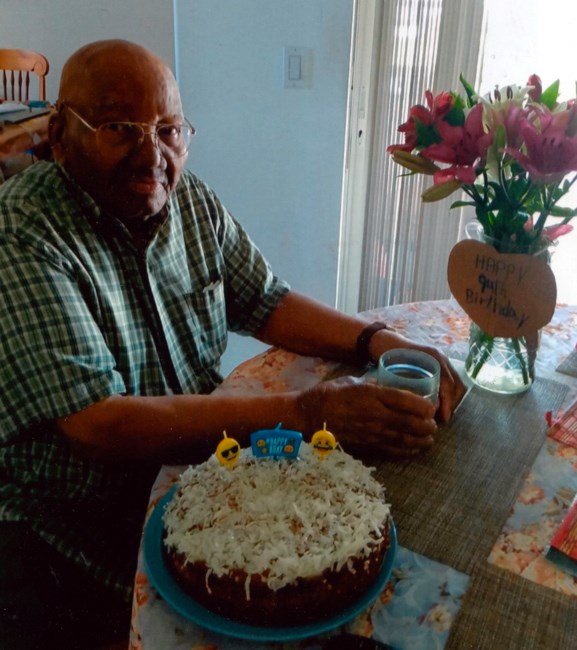
Saint-Louis-du-Sud, a coastal region, provided a bounty of fish, crabs, shrimp, and other sea life for their family's nutritional needs. Barnave loved all kinds of seafood, but mainly fish. He often sat at his dining room table, enjoying a plate of fish covered in red sauce. The fish was often full of bones. Because he grew up eating fish, he could sift out the bones with his mouth without batting an eye.
He mentioned that fish were plentiful in the area since it was a seaside town. Still, caimans also inhabited the vicinity, and the townspeople had to be cautious of them because they were dangerous. These reptiles sometimes killed inadvertent travelers in the community. That may be why he never learned to swim.
Barnave loved various foods and did not shy away from pigs' feet, tongue, brain, and other kinds of specialty foods, but he never ate beef. He had an aversion to it. He ate chicken, pork, and seafood, but never beef. It was more than just a preference because he would never say outright, he did not like beef. Although his children repeatedly tried to cajole him into telling them why he did not eat beef, he never revealed the reason.
Barnave left his childhood home in the big city around the age of seventeen, after which he embarked on the adventure of his life. During his early years, he cherished learning. He was ambitious and hardworking even in his youth. Once he reached a certain level of education, his education stopped. The school was only available in the more populated areas nearby. He wanted to go into this other region to continue with his education after middle school. Still, his father refused to pay for his further study, which angered Barnave. He could not understand why his father would not want him to further his studies since he had been educated himself. This resentment remained with him for the rest of his life. Sometimes, feelings can hold us captive and cloud our judgment. Despite this barrier, he embarked on a series of professions and opportunities until he immigrated to the United States.
His full name at birth was Philippe Barnave Dorante, but throughout his life, he went by the name of Barnave on all official documents in the U.S. When he immigrated to the United States, many co-workers and friends called him "Barny," and some other relations even called him "Bunny."
Barnave was a bright and jovial person who made friends and acquaintances quickly. He and his wife developed a strong group of friends whom they associated with. They all eventually immigrated along with them.
He rarely talked about his childhood. There are some things that he refused to speak about, and one of them was his father. This is one facet of his life that was locked away. Information from his past has only come from other sources like his wife, Eupomene Lauture. She also related that her statements were secondhand. She found this out from her sister-in-law Constance Dorante, a full biological sister. One story she told was how he had gotten a large gash from his leg. She said he had taken off wildly on a mule. As he charged forward, the mule went under an overhanging branch. Barnave fell off and got hurt grievously and was incapacitated for several months until the leg was healed with the help of a neighboring herbalist.
From what was related, Barnave's father was a harsh man who did not tolerate children well. His father had been a magistrate in the local area. The irony was his father had many children with different women he partnered with. It is said that he married Barnave's mother before she died, almost a deathbed marriage. Sometimes he made statements alluding to his humble beginnings, but that is as far as he talked about his past.
During those early years after his schooling ended, he apprenticed with an individual who taught him how to keep the books for a business. While he was there, he became acquainted with the truck drivers in the company. One day he asked one of them to teach him how to drive his truck. The truck driver was disposed to teach him. He also learned how to be a tailor at one point, but the profession was too sedate for him, and he eventually went to the big city. Also, he was a taxi driver and encountered many people, and learned much about life.
While he was in the city, he made many friends and eventually met his future wife's sister. He diligently courted Eupomene Lauture, who would become his future wife. At first, she was skittish, but they eventually tied the knot on March 2, 1956. He settled in Petionville, Haiti, where he and his wife had three children. At one point, he brought a son from an earlier relationship to join his family unit.
At one point, the two decided to leave Haiti because of economic instability and political turmoil. But they had to leave their children behind. Barnave, who loved talking politics, was also in danger. Once he left Haiti, he would not return for over thirty years. Nevertheless, he loved his homeland. For several years he refused to become a citizen of the United States until he realized it was beneficial.
In the early years in New York, Barnave worked as a groundskeeper for a writer in Pomona, New York. Meanwhile, his wife to the care of their household. He did not enjoy this job, and eventually, they moved out. Throughout his thirties, he hustled to make ends meet. They eventually moved to Spring Valley, New York, and had another child Philippe, the apple of his eye. They ultimately sent for the other children, bought a house, and settled for many years on Pascack Road on the borders of Spring Valley, New York.
Once again, he began a new profession. He became a tractor-trailer driver for many years. He was able to become an independent contractor with his own tractor-trailer. He was a risk-taker. For many years he worked many long days to fulfill this dream.
Barnave also had a second dream. It was to retire in Haiti. For many years he worked towards that task. He gradually renovated the old home they had purchased in Haiti when the children were still there. Little by little, he ferried material back and had the house fortified and renovated to suit him. He diligently prepared the home with all the amenities he would need like a generator, appliances, water storage system. He tried to think of everything he would need to live independently and self-sufficiently. He was able to fulfill that dream. Then realized at one point that his wife, who had developed Alzheimer's disease, would be vulnerable if anything would happen to him. So he sold the house and moved to Port Saint Lucie, Florida, where her sister and brother-in-law had retired.
He continued to care for his wife until she became bedridden and moved her to a nursing home where he could visit her daily. She then passed in 2004.
Meanwhile, while his wife was debilitated, he threw all his energies into buying properties and building houses. He tried to convince his family to join him in Florida, but it never worked out.
He decided that he would marry for companionship and joined Zeni Moreira Del Magalhaes as his second spouse. She is a Brazilian woman twenty years younger, who had never been married before.
He attended the Catholic Church, and would regularly watch Catholic services on television. He also loved playing the numbers. It was a passion with him. From the time he was in Haiti, he liked playing the numbers and relied on dreams to reveal what he should bet on.
Once he immigrated to New York, he added the New York lottery to his repertoire.
Barnave lived a full life until the age of ninety-four years old. Unfortunately, he decided after having some dental problems to remove his remaining teeth. The dentist removed eight teeth at once and sent him home without any pain medication or antibiotic. As a result, he suffered from the side-effect of this trauma. He could not eat or drink, eventually had a fever, and ended up in the hospital. After a brief hospital stay, he was sent to a nursing home for therapy, which did not help. He was distraught at the situation, especially since he had all his mental faculties. In the evening, he began having chest pains. He was sent to Lawnwood Hospital, where he passed on December 15, 2020, almost a month after his youngest son's death.
Show your support
Add a Memory
Share Obituary
Get Reminders
Services
SHARE OBITUARYSHARE
- GET REMINDERS
v.1.18.0